the light your absorber missed, sent back.
Q-Reflect is a rear light-management layer for thin optoelectronic devices: a few nanometers of metal, self-assembled into sub-wavelength islands that return weakly absorbed near-infrared light through the absorber at steep angles.
where Q-Reflect sits in the stack
in a quantum-dot infrared sensor, the layer goes onto the readout wafer before the quantum dots are added, so the light-sensitive layer never sees the process. near-infrared light that crosses the thin absorber once gets a second, longer pass.
in an opaque perovskite cell, the layer sits between the absorber and the back electrode. visible light is absorbed on the first pass; the gain comes near the band edge, where a sub-micron absorber lets light through.
in an all-perovskite tandem, the narrow-bandgap bottom cell has the weakest absorption near its band edge. the layer sits behind it, so that cell can stay thinner.
exploded view, not to scale. layers range from a few nanometers to about a micron thick.
how it is made
deposit
a thin oxide spacer, then a metal film a few nanometers thick, on standard deposition tools.
self-assemble
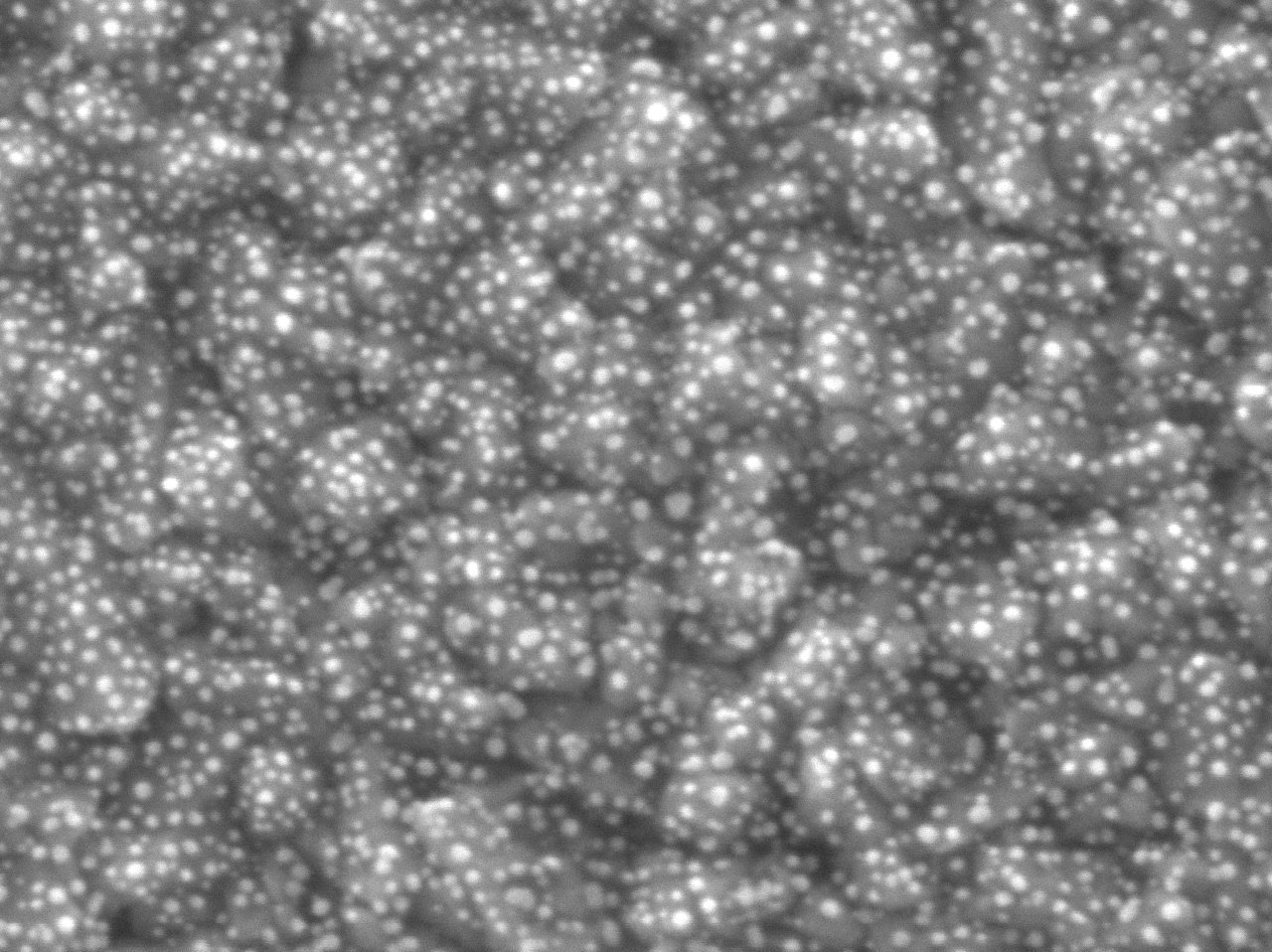
a short thermal step beads the film into a dense field of sub-wavelength islands. no lithography, no masks.
integrate
added during device fabrication, behind the absorber. the absorber and the front surface stay as they are.
modeled and imaged
the design is modeled with wave-optics and transfer-matrix simulation, and the island morphology is imaged by field-emission electron microscopy at Coppin State University. in simulation, the gain is largest where the absorber is weakest. device-level measurements are next.
absorption at 1545 nm in a 300 nm PbS quantum-dot film
photocurrent in a 400 nm perovskite solar cell
simulations performed with Setfos (Fluxim AG), evaluation version. PbS quantum-dot optical constants from Chehaibou et al., Nanoscale 14, 2711 (2022).
developed with Coppin State University in Baltimore, Maryland.
work with us
we take on engineering projects that apply Q-Reflect to a partner's own device stack: sensor makers, research groups and defense laboratories.